
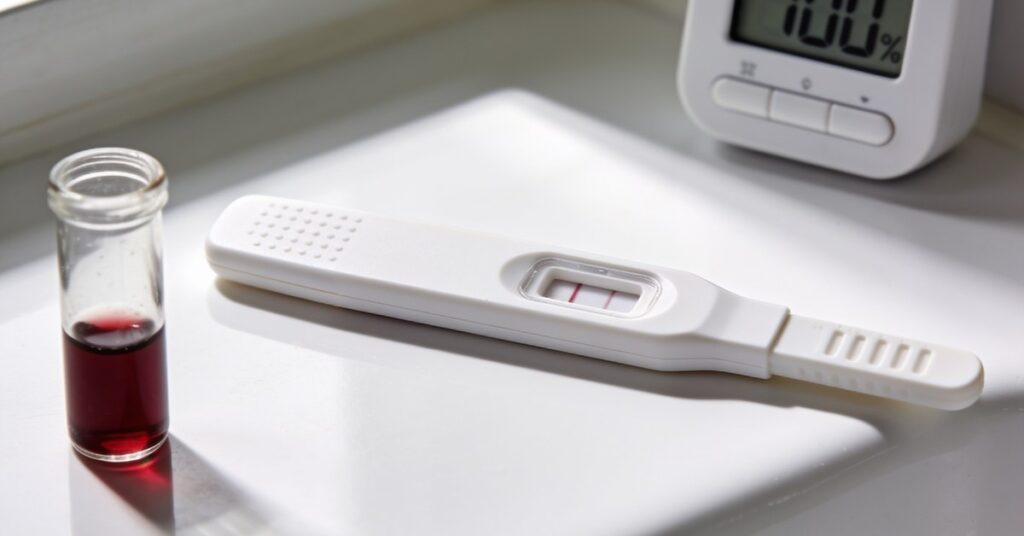
Navigating the uncertainty of early pregnancy requires clarity, and knowing how to accurately test your hCG levels at home is a vital step in managing your reproductive health with confidence. In this guide, you will learn the evidence-based protocols for both urine and blood testing, how to interpret your results correctly, and the specific factors that influence diagnostic accuracy. By following these professional insights, you can approach your testing process with the preparation and peace of mind you deserve.
Understanding hCG Levels At Home And Early Pregnancy Diagnostics
Testing human chorionic gonadotropin (hCG) at home is the primary method for confirming early pregnancy, as this hormone is produced by the placenta shortly after implantation. When you decide how to test hcg levels at home, you must choose a method that aligns with your specific needs, whether that involves a standard qualitative urine test or a more precise quantitative blood assessment. Understanding the biology behind this hormone—which typically doubles every two days during the first weeks of pregnancy—is essential for interpreting whether your test results fall within the expected range for your stage of gestation. This initial phase of self-diagnosis is not just about the result; it is about taking control of your health data, which is why I always recommend keeping a consistent log of your testing journey.
Optimal Timing And Tips For Accurate Home HCG Level Test Results
The most reliable time to perform a home test is on the first day of a missed period, which offers up to 99% accuracy when performed correctly. For the highest concentration of the hormone, always use your first morning urine, as it has not been diluted by fluid intake throughout the day. If your cycle is irregular, use this checklist to decide when to act:
- If the next period date is unknown: Wait at least 21 days after unprotected sex.
- For ultra-sensitive tests: Can be used up to 6 days before an expected period.
- Standard testing: Wait for the first day of a missed period for maximum accuracy.
Testing too early often results in a false negative because the concentration of the hormone in your system simply hasn’t reached the threshold required for detection. From my perspective, patience is your best ally here; waiting until the first day of your missed period provides the most definitive answer, sparing you the unnecessary anxiety of inconclusive results.
Standard Urine Test Strip Procedures For Home Pregnancy Tests
Standard urine tests are highly effective diagnostic tools that provide a simple way to detect pregnancy at home with 97-99% accuracy when used a week or two after a missed period. If you are researching how to test hcg levels at home, you will find that the physical technique matters as much as the timing of the test. From my experience, keeping a simple log of your testing dates and results is a great way to stay organised and reduce stress during this waiting period. Follow these steps to ensure you get a valid reading:
- Pee directly onto the absorbent tip for 5–10 seconds.
- Avoid submerging the strip past the marked „Max” line to prevent flooding the mechanism.
- If using a pipette, carefully add 3 drops of urine to the sample well.
- Lay the test flat on a clean surface and wait exactly 3 to 5 minutes.
The importance of following the manufacturer’s specified waiting time cannot be overstated. I have seen many people panic after seeing a line appear after the 15-minute mark, but that is rarely a reliable indicator of anything other than evaporation. Stick to the clock and trust the process as it is outlined in the kit’s documentation.
Exploring At-Home Quantitative Blood Test Kits And Lab Services
You can measure specific hCG levels at home using a finger-prick capillary blood test, which provides a more precise, quantitative result than standard sticks. Selecting the right kit depends on your need for speed and sensitivity; the following table compares some of the common options available in the UK:
| Test Provider | Sample Type | Turnaround | Key Feature |
|---|---|---|---|
| Mayfield Clinic | Finger-prick | 1 Day | Quantitative (£68.45) |
| SELFCHECK | Blood | Variable | MHRA/CE Certified |
| London Health Co | Blood | Lab-based | Ultra-Sensitive |
These quantitative blood tests are particularly useful if you require a precise numerical value rather than a simple 'yes’ or 'no’ answer. They offer a level of clinical insight that is often preferred by those who want to monitor their early hormone progression with professional, lab-verified accuracy.
Interpreting hCG And Types Of Home HCG Tests
Interpreting your result requires looking for specific line formations within the manufacturer’s designated time frame, typically 3 to 5 minutes. A positive result is indicated by two lines appearing—one in the Control (C) region and one in the Test (T) region, even if the T-line is faint. A negative result shows only a single line in the C region, while an invalid result occurs if no lines appear or if only a T-line is visible without a C-line. Important: Always ignore any marks that appear after 10–15 minutes, as these are often „evaporation lines” that do not signify a pregnancy.
Many people find the faint T-line confusing, but in the context of home diagnostics, a faint line is still a positive result. If you are in doubt, the best course of action is to retest after 48 hours, as the hormone concentration should have naturally increased, making any subsequent line significantly darker and easier to read.
Physiological Factors Affecting HCG In Urine And Blood
Several variables can influence the detectable concentration of hCG, potentially leading to inaccurate readings if not carefully managed. Ever wondered why a test might say negative even when you feel pregnant? Drinking excessive fluids can dilute your urine, thereby lowering the hormone concentration and potentially causing a false negative. Keep these factors in mind if your results seem inconsistent:
- Fertility treatments: Trigger shots containing hCG can cause residual hormone levels, leading to a false positive.
- The „Hook Effect”: Extremely high levels of hCG can saturate test antibodies, causing a false negative.
- Recent pregnancy: Previous miscarriage, delivery, or termination can leave residual hCG in your system.
Understanding these biological nuances is crucial for any man or woman taking an active role in their health management. If you are undergoing fertility treatments, always discuss the timing of your tests with your specialist, as residual hormone from trigger shots can linger and skew your results for several days.
Monitoring Progression With Serial At-Home HCG Blood Test Methods
Serial testing allows you to track the progression of your pregnancy by observing whether the intensity of the test line increases over time. To ensure consistency, use tests from the same brand and the same box, as sensitivity levels can vary significantly between manufacturers. Take a clear picture of your test results side-by-side to help you compare them over a few days, though remember that urine tests generally detect hCG only 2 weeks after conception, whereas blood tests are capable of confirming pregnancy as early as 11 days after. When considering how to test hcg levels at home over a period of time, the key is standardisation; changing brands mid-cycle can introduce variables that make it impossible to track your levels accurately.
When To Consult A Healthcare Provider After Testing
You should consult a healthcare provider if you receive a negative result but still suspect pregnancy, in which case you should take another test one week after your missed period. If you receive a positive result, it is advisable to wait about a week before calling your Ob/Gyn office to schedule your initial consultation. Remember: Once pregnancy is confirmed, you will typically be scheduled for monthly doctor visits until 30-32 weeks, after which appointments usually increase to every two weeks to ensure the health of both parent and child.
Frequently Asked Questions
Can medications cause a false positive result?
Yes, certain fertility medications containing synthetic hCG can lead to a false positive result on a home test. These substances remain in your system for some time, so it is vital to discuss the timing of your test with your medical specialist.
Is there a specific time of day that is best for testing?
Testing with your first morning urine is strongly recommended to ensure the highest hormone concentration. This simple step significantly improves the accuracy of your results, especially in the very early stages of pregnancy.
What should I do if my test result is invalid?
An invalid result, often marked by the absence of a control line, means the test failed to function correctly. You should discard the device and repeat the procedure using a fresh kit from a new package.
Do I need an appointment for a blood test?
If you choose a home-based blood test kit, you do not need an appointment, as these are designed for self-collection via a finger-prick. However, if you have concerns about your health, consulting a healthcare provider for a formal laboratory assessment is always the safest course of action.
Always prioritise the use of first-morning urine to ensure the highest hormone concentration for your test. Remember that patience is your greatest ally, so waiting until the first day of a missed period will give you the most accurate and reliable result possible.