Finding a sustainable and efficient approach to weight management is a common challenge, yet many individuals struggle to identify which exercises truly offer the best return on their physical investment. In this article, you will discover whether skipping is a scientifically sound method for fat loss, learn exactly what to expect from a typical session, and receive practical guidance on how to safely integrate this high-intensity activity into your daily routine. By understanding the physiological benefits and common pitfalls, you can confidently determine if jump rope is the right tool to help you achieve your personal health goals.
Is skipping good for weight loss
Skipping serves as a remarkably potent method for shedding excess weight. As a demanding, whole-body workout, it has the capacity to incinerate approximately 10 to 16 calories every minute. Engaging in just 10 to 20 minutes of high-intensity interval training daily can lead to a significant calorie deficit and provide a substantial boost to your metabolic rate.
The efficacy of skipping for fat reduction
While jumping rope is a formidable tool in any weight-loss regimen, the actual rate and total amount of weight lost will differ based on the individual. The effectiveness of your routine depends heavily on consistency and duration; questioning whether five, thirty, or daily sessions are optimal is natural, as the key to success lies in structured progression.
Please note that this content is for informational purposes and does not serve as medical advice or a formal diagnosis. Jumping rope is particularly effective at reducing total body fat, including stubborn abdominal areas.
Primary advantages of jump rope training
- Significant Calorie Expenditure: A brief 20-minute session can burn up to 300 calories, far outpacing the efficiency of steady-state activities like brisk walking or jogging.
- Total Body Engagement: The movement works your calves, hamstrings, quadriceps, core, and shoulders in one fluid motion.
- The Afterburn Effect: Due to the high intensity involved, your metabolic rate remains elevated post-workout, ensuring your body continues to oxidise fat even after you have finished.
- Unparalleled Convenience: It requires virtually no setup—only a small amount of space and an inexpensive piece of equipment.
Achieving sustainable weight loss
While skipping provides excellent results, it is most effective when utilised as part of a comprehensive strategy. The foundation of fat loss remains a consistent caloric deficit, meaning you must consume fewer calories than you expend. Therefore, coupling your skipping sessions with a nutritious, calorie-managed diet is essential for achieving and maintaining your long-term health goals.
Practical advice for your routine
If you are a novice, it is wise to be cautious. Start with brief five-minute intervals to prevent issues like shin splints or unnecessary joint strain, and increase your duration incrementally toward 15 to 30 minutes.
Safety and health considerations
- Prioritise Equipment: Always wear supportive trainers and choose a cushioned surface, such as a rubberised gym mat or timber flooring, instead of hard concrete.
- Technique: Keep your jumps low to the ground to minimise impact forces on your joints.
- Seek Professional Guidance: If you suffer from underlying heart conditions, arthritis, or severe joint problems, consult a medical professional before beginning a new training programme.
Supplementary benefits
Beyond weight management, jumping rope offers several holistic advantages, including improved cardiorespiratory fitness, enhanced mental well-being, increased muscular and bone strength, and the undeniable benefit of being an accessible and affordable form of exercise.
Is Skipping Good For Weight Loss And Efficient Calorie Burning?
Skipping is an exceptionally effective exercise for weight loss because it facilitates a high rate of caloric burn while simultaneously engaging multiple muscle groups to boost metabolic activity. Many people often ask, IS SKIPPING GOOD FOR WEIGHT LOSS, and the answer lies in the high intensity of the movement which creates a significant energy deficit. By incorporating this form of plyometric training into your weekly schedule, you can create the necessary energy deficit required to reduce body fat. Scientific consensus suggests that because a deficit of approximately 3,500 calories is required to lose one pound of body fat, the high intensity of jumping rope makes it a superior choice for those looking to accelerate their progress compared to lower-intensity activities.
Caloric Expenditure And Metabolic Impact Of Skipping Rope Workouts
The primary driver behind the weight loss efficacy of skipping is its ability to burn between 10 and 20 calories per minute, depending on your individual body mass and the intensity of your movement. For an average person weighing 181 pounds, the body consumes roughly 17 calories per minute, demonstrating the significant metabolic demand placed on your system. A 30-minute session can yield a total expenditure of 300 to 600 calories, which is a substantial contribution to your daily energy balance. When you evaluate the question, IS SKIPPING GOOD FOR WEIGHT LOSS, you must consider that your body mass dictates the specific caloric yield, meaning heavier individuals will inherently expend more energy during the exact same duration of jumping.
Variability In Skipping Rope Weight Loss Based On Body Weight
Your personal weight significantly influences the exact number of calories burned during a workout, as the body requires more energy to move a larger mass.
| Body Weight | Time Duration | Estimated Calories Burned |
|---|---|---|
| 120 lbs (54 kg) | 20 minutes | ~160 kcal |
| 200 lbs (91 kg) | 20 minutes | 241–362 kcal |
Quantifying Progress Through Minutes Of Skipping And Repetitions
Measuring your workout by the number of rotations can provide a clear metric for tracking your energy expenditure. Completing 1,000 skips burns approximately 140 to 190 calories, serving as a reliable benchmark for those who prefer counting repetitions over timing their sessions. Furthermore, maintaining a pace of 100–120 skips per minute corresponds to a MET (Metabolic Equivalent of Task) value of 11.8, which classifies skipping as a vigorous-intensity activity that is highly beneficial for cardiovascular health and fat oxidation. If you are diligent about tracking your metrics, you will find that the consistency of your output directly correlates to the speed of your transformation.
Why Jump Rope Is Better For Weight Loss Than Running
Skipping rope is often superior to running for weight loss because it provides a more time-efficient method of burning 700 to 1,000 calories per hour while engaging a wider array of muscle groups. While both exercises are excellent for cardiovascular health, skipping is estimated to be 25–30% more efficient at burning calories than jogging. This efficiency allows individuals with limited time to achieve significant results, as skipping rope burns about 100 calories in just 10 minutes of effort. When considering the query, IS SKIPPING GOOD FOR WEIGHT LOSS, it becomes clear that the ability to perform this exercise in restricted spaces gives it a distinct advantage over running, which may require specific outdoor terrain or access to a gym.
Muscular Engagement And Benefits Of Skipping Rope
The full-body engagement of skipping rope surpasses that of running by recruiting the core, calves, shoulders, arms, and back simultaneously, whereas running primarily targets the quads, hamstrings, glutes, and calves. Beyond muscular recruitment, the practical advantage of skipping lies in its accessibility; it can be performed in small indoor or outdoor spaces with minimal equipment. Conversely, running requires no equipment other than quality running shoes, yet it often necessitates larger, open environments that may not be available to everyone.
The Role Of Diet To Contribute To Weight Loss
While exercise is a powerful tool, it is essential to acknowledge that diet accounts for 80% of weight loss effectiveness. Attempting to use physical activity to compensate for a poor diet is a common error that prevents long-term success. To ensure your efforts lead to lasting fat loss, you must maintain a consistent calorie deficit through balanced nutrition alongside your skipping routine.
Designing Jump Rope Workouts To Lose Weight
To successfully integrate skipping into your lifestyle, you should aim for 15 to 30 minutes of activity several times a week, adjusted according to your current fitness level. Beginners should start with a manageable 5 to 10 minutes daily to allow the body to adapt to the high-impact nature of the movement. Consistency is the cornerstone of any weight loss programme, and establishing a regular frequency of 3 to 5 times per week will yield the most sustainable results.
Progression And Intensity Of Rope To Lose Weight
Ever wondered if there’s a faster way to manage your fitness progression? Your session duration should evolve as your cardiovascular endurance improves, moving from initial 10-minute beginner sessions to 15–20 minutes for intermediate levels.
- Beginner: 5–10 minutes daily (30s jump / 30s rest).
- Intermediate: 15–20 minutes per session.
- Advanced: 20–30 minutes sustained or HIIT, 3–5 times per week.
- Intense: 30–40 minutes, at least 3 times per week.
Implementing Interval Training For Belly Fat Loss
Interval training is the most effective way to structure your workouts to boost fat loss and improve metabolic recovery. Beginners should start with a simple structure of 30 seconds of jumping followed by 30 seconds of rest. This approach prevents premature exhaustion and allows you to maintain proper form, which is critical for long-term injury prevention and consistent performance.
Health Benefits Of Skipping Rope And Full Body Fat Loss
Skipping rope is a form of plyometric exercise that effectively burns calories while simultaneously stimulating muscle toning and bone density. By performing two to five minutes of weight-bearing exercise daily, you can actively bolster your skeletal health. While significant muscle hypertrophy typically requires external resistance beyond your own body weight, the consistent engagement of the calves, quads, hamstrings, glutes, core, shoulders, and upper arms during jumping provides excellent muscular endurance benefits.
Targeting Belly Fat With A Good Workout
Skipping is particularly effective for belly fat reduction because it engages the abdominal, lower back, and deep core muscles to maintain balance and absorb the impact of every jump. This constant core activation helps to tighten the midsection while the overall high-intensity nature of the exercise burns the fat stores covering those muscles. A recommended routine for this purpose involves 10 to 20 minutes, 3 to 4 times a week, utilizing a HIIT structure of 30 seconds of fast jumping alternated with 10 seconds of rest.
Essential Techniques And Safety For Trying To Lose Weight
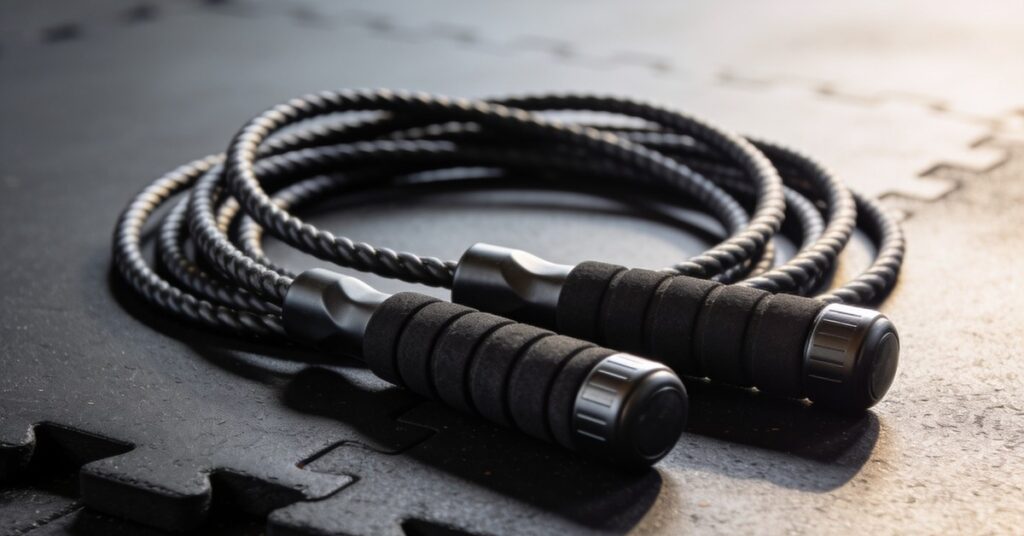
Starting a skipping rope workout safely requires a 5-minute warm-up and proper equipment sizing to ensure you do not strain your joints. You can size your rope by standing in the middle; the handles should reach your armpits when pulled taut. From my experience, keeping a simple log of your jump counts helps you stay motivated and track your improvement over time.
Executing The Perfect Jump For Jump Rope For Weight Loss
- Perform a 5-minute warm-up to prepare your joints.
- Jump only 1–2 inches off the ground.
- Land softly on the balls of your feet with knees slightly bent.
- Keep elbows tucked close to your ribs.
- Maintain a steady rhythm practicing „shadow jumping” first.
Avoiding Common Mistakes When Using A Rope To Lose Weight
The most common mistake when starting is jumping on concrete, which can lead to stress injuries; always use a flat surface or a shock-absorbing mat. Furthermore, ensure you do not use a rope that is too light, as it makes it difficult to feel the position of the rope during the rotation, leading to poor timing and frustration. Always focus on a single-bounce rhythm where one skip corresponds to one rope spin, avoiding the „double jump” or „donkey kick” where you hop twice per rotation.
Important: Do not attempt to out-jump a poor diet; maintaining a calorie deficit is the primary driver of weight loss success, not just the exercise itself.
Frequently Asked Questions
Is skipping rope safe if I have never done it before?
Yes, skipping is safe for beginners provided you start with short, 5-minute sessions and focus on proper landing technique. Always ensure you are jumping on a shock-absorbing surface to protect your joints from unnecessary impact.
How many calories does a 10-minute session burn?
A 10-minute jump rope session typically burns approximately 100 calories for an average-sized adult. This rate can increase significantly if you perform high-intensity interval training during those 10 minutes.
Do I need a special type of rope for weight loss?
You do not need an expensive rope, but you should avoid ropes that are too light as they provide poor feedback. Look for a weighted or standard speed rope that reaches your armpits when you stand on the centre.
Can skipping help me lose weight without changing my diet?
While skipping burns significant calories, it is rarely enough to lose weight effectively if your caloric intake remains too high. You must maintain a caloric deficit, as diet accounts for the majority of weight loss results.
Skipping rope remains one of the most efficient, accessible, and versatile tools in any weight loss toolkit, provided it is approached with the correct technique and a focus on nutritional balance. Prioritize a single-bounce rhythm and maintain a consistent caloric deficit to ensure your progress is both sustainable and kind to your body.