
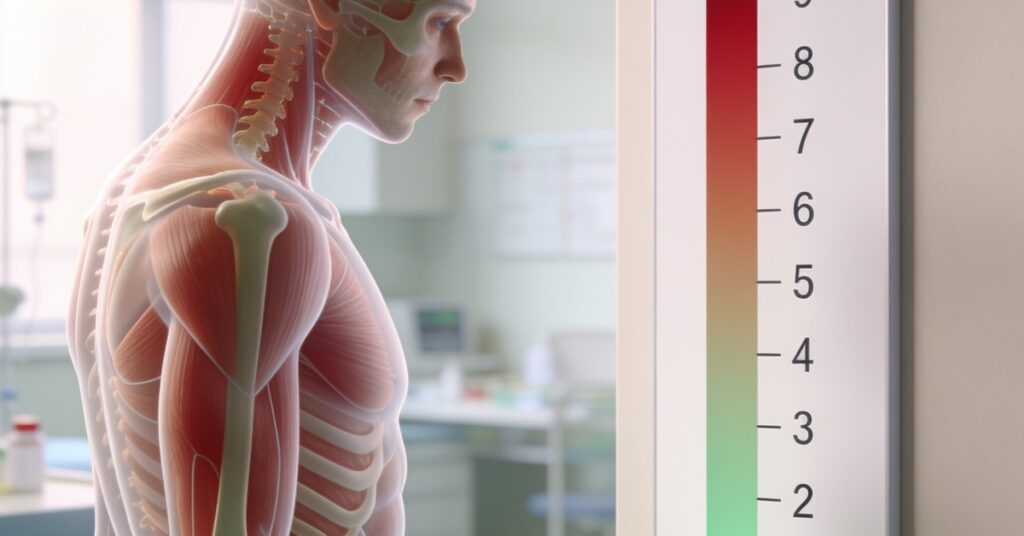
Accurately communicating the intensity of your discomfort is a vital step in effective pain management and ensuring you receive the appropriate care from your healthcare team. In this guide, I will break down the Pain Scale 1 10 Examples using clear, evidence-based insights so you can confidently assess your own symptoms and prepare for productive consultations with your doctor. Understanding how to navigate this tool allows you to take control of your health journey, even when you are facing challenging physical sensations, as the pain scale is a simple yet powerful communication instrument designed to help you quantify pain in a structured manner.
Pain scale 1-10 examples
The numerical pain scale ranging from 1 to 10 functions as a subjective clinical assessment tool, allowing patients to quantify their discomfort. On this 11-point spectrum, zero signifies an absence of pain, whilst ten represents the most excruciating sensation a person can conceive. Medical professionals utilise these scores to monitor the efficacy of therapeutic interventions, categorising them as mild (1–3), moderate (4–6), and severe (7–10).
Interpreting the 1-10 pain scale
- 0: No pain. You feel perfectly comfortable and at ease.
- 1–3 (Mild): You are aware of the sensation, yet it is easily dismissed. It does not hinder your daily routines. Examples include a slight headache, a minor scratch, or the fleeting twinge of a healing bruise.
- 4–6 (Moderate): The pain is distracting and more challenging to ignore. It may interfere with tasks such as eating, reading, or walking. Examples include a lingering toothache, a migraine, or a sprained ankle that requires you to alter your gait.
- 7–10 (Severe): This level of pain commands your full attention, making normal activity feel unachievable. You may struggle to hold a conversation or get any sleep.
- 7–8: Intense and difficult to endure, such as a fractured bone or significant back pain.
- 9: Excruciating, agonising pain that may result in involuntary moaning, often associated with kidney stones or labour contractions.
- 10: Unimaginable, peak pain that may cause a patient to lose consciousness or experience delirium.
Assessing your level of discomfort
The pain scale categorises discomfort into levels that reflect how much your condition impacts your ability to function throughout the day. Severe pain is particularly disabling, often leading to uncontrollable crying or persistent moaning, which prevents the completion of standard daily responsibilities.
Considerations for diverse patients
It is important to recognise that pain tolerance is highly individual. Those who suffer from chronic conditions may develop a higher threshold, which can skew self-reported numbers. Consequently, many clinicians supplement the numerical scale with functional assessments, such as the Wong-Baker Faces chart, to gain a more comprehensive understanding of the patient’s experience.
Clinical application
A healthcare practitioner will typically request a pain rating both before administering a treatment or medication and again approximately one hour afterwards to evaluate the clinical response. Please note that this information is provided for educational purposes and does not substitute professional medical advice, diagnosis, or clinical assessment.
Summary table of pain metrics
- Word scale descriptions: Ranging from none to worst imaginable.
- Number scale: 0 to 10 intervals.
- Activity tolerance: Assessing how pain limits movement and daily participation.
Understanding the Numerical Pain Rating Scale and How to Use the Pain Scale
The Numerical Pain Rating Scale (NPRS) is the formal, internationally recognised tool used by healthcare professionals to quantify pain intensity for patients aged eight years and older. By assigning a numerical value from 0 to 10, patients can provide their clinicians with a standardised reference point that helps in the immediate assessment of their condition and the subsequent planning of treatment interventions. When you feel pain, this scale helps translate your subjective experience into data that doctors can track over time, allowing for a more precise evaluation of how different therapies influence your overall well-being.
To use the pain scale effectively, you should evaluate your average pain level over the last 24 hours or the past week, rather than focusing solely on a momentary spike in discomfort. Remember: Rating your pain both before and after receiving any form of intervention, such as taking prescribed medication or completing a physical therapy session, provides your doctor with tangible evidence regarding the efficacy of your current pain treatment. Many patients who rated their pain find that tracking these changes is essential for adjusting dosages, especially when painkillers are only partially effective in managing complex symptoms. By keeping a consistent record, you help your pain specialist understand the nuances of the sensation of pain you experience throughout the day.
Furthermore, the numeric pain rating scale serves as a universal language in hospitals and clinics. Whether you are dealing with acute injury or chronic pain, being asked to describe your discomfort in a numeric format provides a baseline. It is crucial to be honest; choose the same number consistently if the feeling remains stable, but do not hesitate to adjust it if the pain changes significantly. This simple pain assessment tool is the foundation of any multidisciplinary approach to pain management, ensuring that your voice is heard throughout the treatment process.
Categorising Pain Intensity and Describing Pain Levels
The 1–10 pain scale is divided into three distinct intensity tiers to help clinicians and patients establish a common language for describing subjective physical suffering. These tiers—mild pain, moderate pain, and severe pain—serve as a framework for determining the urgency of medical evaluation and the aggressiveness of therapy required to restore comfort. Because pain is subjective, this range of pain helps bridge the gap between how you feel and how your provider understands your condition, ensuring no one is left struggling in silence.
From Mild Discomfort to Debilitating 10 Pain
At the bottom of the scale, 0 means no pain, while levels one to three represent mild pain that is noticeable but does not significantly interfere with your daily activities or focus. Moving into the moderate range, levels four to six represent pain that is distracting enough to interfere with your routine, often requiring you to make specific adjustments to your day to cope. For many, a score of 4 to 6 is still distracting and moderately strong pain that warrants attention. Finally, levels 7 to 10 represent severe pain, intense and disabling, that dominates your senses and prevents you from performing normal daily activities; 10 means the worst pain imaginable, comparable to the experience of childbirth or the acute agony of passing a kidney stone. When you hit a level where the pain interferes with sleep, you are likely in the dangerous territory of 7 to 10 on the scale.
Real-World Pain Scale 1 10 Examples for Each Type of Pain
Using concrete Pain Scale 1 10 Examples helps translate the abstract numbers of the pain measurement into relatable physical experiences, making it easier for you to accurately report your status to a doctor. Dealing with these symptoms can be frustrating, but I’ve found that keeping a simple pain log helps me stay on top of things during a flare-up. When you describe your pain, consider the area of the body and the type of pain, whether it is sharp, aching, or throbbing, as these factors of pain are essential for a clear pain report.
| Pain Level | Intensity Description | Clinical Example |
|---|---|---|
| 1–3 | Mild | Papercut, minor bruise, or tension headache |
| 4–6 | Moderate | Deep muscle bruise, whiplash, or sports tear |
| 7–10 | Severe | Broken bone, migraine, or gunshot wound |
It is important to note that 75 percent of patients who rated their pain between 4 and 7 also described it as something that interferes with sleep or social activities. Indeed, research found that about 75 percent of patients who rated their pain between 4 and 7 also described it as a persistent burden. If your pain interferes with your ability to function, it is a clear indicator that your current pain management strategy may need a multidisciplinary approach to pain management, as 10 pain is a medical emergency that requires immediate intervention. Whether it is bad back pain or a minor injury, comparing your pain to these benchmarks allows for better communication with your healthcare provider.
Clinical Assessment for Children and Older Adults to Assess Pain
For individuals who cannot use the standard Numeric Pain Rating Scale (NPRS), such as young children or non-verbal older adults, clinicians rely on validated observational tools like the FLACC scale, the faces scale, or the Defense and Veterans Pain Rating Scale. These tools allow for a structured assessment of pain without requiring the patient to assign a specific number themselves. By using these alternatives, we ensure that every person’s pain is accounted for, regardless of their ability to communicate or their level of pain tolerance.
The FLACC scale, first published in 1997, assesses five categories: Face, Legs, Activity, Cry, and Consolability, with each category scored from zero to two for a maximum total of ten. Additionally, the faces scale, which is typically used for children ages three and up, consists of six drawings of faces that represent increasing levels of pain. For older adults and those who are able to communicate, the NRS remains the primary metric, while the Visual Analogue Scale (VAS), which uses a 10 cm line for the patient to mark their pain, offers another reliable alternative to numeric reporting. Always remember that pain often changes, and the tool used to measure pain should be consistent throughout your treatment. Whether you are using the veterans pain rating scale or a standard faces scale, the goal is to quantify pain accurately.
Subjective Experience Versus Objective Pain Measurement
The core challenge of the 1–10 scale is that it requires patients to convert a deeply personal, subjective feeling into a quantitative number, which can be difficult to standardise across a diverse patient population. While subjective scales are essential for capturing the patient’s perspective, they differ significantly from objective pain scales that rely on measurable biological data such as heart rate or blood pressure. This discrepancy is one of the primary factors of pain assessment that clinicians must navigate when trying to manage a person’s pain effectively.
To improve accuracy, modern clinical models are evolving toward more rigorous assessment frameworks. Research such as the 2021 study by AK Pace, titled „An Objective Pain Score for Chronic Pain Clinic Patients,” and the 2018 publication by TH Wideman, „The Multimodal Assessment Model of Pain,” highlight the move toward integrating subjective patient reports with objective markers. This multimodal approach ensures that the 0–10 or 0–100 ranges are interpreted within a broader context, ensuring that 0 means no pain and a ten represents the absolute maximum threshold. Understanding that pain is subjective allows you to communicate pain levels more effectively with your pain specialist, as they can then adjust treatment based on both your report and clinical observation.
Navigating Where the Pain Scale Falls Short in Chronic Pain
The 0–10 Numeric Pain Rating Scale (NPRS) has inherent limitations in clinical settings, most notably the lack of standardised cut-off points across different medical studies and patient populations. A 2007 study by EE Krebs demonstrated that the scale has only modest accuracy for identifying clinically important pain in primary care, and a 2018 review reinforced the concern that the scale fails to capture functional interference, such as the ability to walk, work, or sleep. Chronic pain patients often find that the scale describes their baseline poorly, especially when the pain is constant but fluctuating or when the pain scale falls short of capturing the complexity of their condition.
Furthermore, patients often encounter the „ceiling effect,” where those rating their pain as a ten cannot quantify further increases in intensity, and the „floor effect,” where chronic pain patients with a baseline of four struggle to report minor, yet meaningful, fluctuations. A 2025 study by Monticelli notes that using a score of three or four as a threshold for intervention is often inadequately validated, which is why experts recommend using the PEG scale—which measures Pain, Enjoyment of life, and General activity—as a supplement to address these functional limitations. If you find that the scale works poorly for your condition, discuss it with your doctor to create a more personalised pain report. Combining these tools helps overcome the fact that painkillers are only partially effective for many chronic pain patients.
How to Accurately Describe Your Pain Score to Your Doctor
You can improve the quality of your medical consultation by using the 1–10 scale to describe your pain with precision, ensuring your doctor understands exactly how your condition affects your life. Ever wondered if there is a more structured way to describe your symptoms to your GP? Using a scale of 1 to 10 helps you compare your pain to past experiences, but providing context is the key to better care. When you are asked to describe your discomfort, try to think about how much pain is involved in an activity versus when you are resting.
- Prepare a summary of your pain intensity over the last 24 hours or the past week.
- Note specific triggers, such as movement or weather, that increase your pain score.
- Mention how the pain impacts your sleep, work, or ability to perform normal daily activities.
- Ask your doctor if a pain management plan update is required based on your reported scores, especially if your current medication only helps to reduce pain for 3-4 hours.
- Keep a detailed pain log so you can provide a retrospective pain report at your next visit.
Why Healthcare Providers Rely on Pain Score Data
Doctors use the 1–10 scale, officially known as the Numerical Pain Rating Scale (NPRS), as a fundamental component of treatment planning and monitoring patient progress over time. This system allows for a quick, consistent method of tracking whether a specific medical intervention, such as a new medication or physical therapy, is successfully reducing a patient’s pain levels. When you rate pain, you are providing a snapshot of your current reality which, while simple, is a vital part of the clinical process. It provides a useful pain index that can guide adjustments to your care.
The scale categorises pain into mild (levels 1–3), moderate (levels 4–7), and severe (levels 8–10), which helps clinicians prioritise care based on the urgency of the patient’s symptoms. For paediatric patients or those with communication barriers, doctors often utilise the Wong-Baker FACES Pain Rating Scale, which was introduced in 1983 to provide a more inclusive assessment method. While it is worth noting that 59 percent of respondents in the ArthritisPower registry reported that a numbering system was not an effective method to measure their specific pain, the NRS remains a standard, widely understood tool that serves as a vital starting point for the doctor-patient dialogue regarding discomfort management. Remember, even if you choose the same number for a long time, reporting it helps the doctor understand that the condition remains stable or is not responding to current therapy.
Frequently Asked Questions
Can the Pain Scale 1 10 Examples be used for emotional distress?
While the numeric scale is primarily designed for physical sensations, some providers adapt it for psychological distress to gauge the severity of symptoms. However, it is not a clinical diagnosis tool for mental health and should always be accompanied by a professional psychological assessment to ensure a holistic view of the patient’s well-being.
What should I do if my pain intensity fluctuates throughout the day?
Keep a simple log noting the highest and lowest scores you experience during a 24-hour period to help your doctor identify patterns. This provides a more accurate overview than trying to pick a single number that represents your entire day, especially if you suffer from bad back pain that changes with activity or time.
Does a high pain score always indicate a serious injury?
Not necessarily, as pain perception is subjective and can be influenced by inflammation, stress, or nervous system sensitivity. A high score requires medical attention to determine the underlying cause, even if the visible injury appears minor, as pain is a complex warning signal from your body that requires professional evaluation.
Are there alternatives if I find the 1-10 numbering confusing?
You can describe your pain using functional terms, such as whether it prevents you from sleeping, eating, or performing basic self-care tasks. Doctors often value these descriptive details as much as, or sometimes more than, a specific number on a scale, as it helps them understand the real-world burden of your condition beyond just the number.
Mastering the use of Pain Scale 1 10 Examples is one of the most practical steps you can take to become an active, informed participant in your own healthcare. Important: Always keep a record of your medication schedule and side effects to assist your doctor, as combining numerical data with clear descriptions of your functional limitations creates the most accurate picture of your recovery journey.